Danbooru
Login Posts Comments Notes Artists Tags Pools Wiki Forum More »
Listing Upload Hot Changes Help

Search

  • Help
guro
scat
furry -rating:g

Artist

  • ? azel (laevateinn495) 212

Copyright

  • ? touhou 1.1M

Characters

  • ? flandre scarlet 64k
  • ? koakuma 16k
  • ? patchouli knowledge 39k

General

  • ? 3girls 334k
  • ? blonde hair 2.2M
  • ? blush stickers 164k
  • ? chibi 391k
  • ? fang 465k
  • ? hair ribbon 810k
  • ? hat 1.7M
  • ? head wings 96k
  • ? long hair 6.4M
  • ? math 1.6k
  • ? multiple girls 2.2M
  • ? necktie 685k
  • ? purple eyes 1.2M
  • ? purple hair 937k
  • ? red eyes 1.8M
  • ? red hair 754k
  • ? ribbon 1.5M
  • ? stick 9.3k
  • ? teaching 558
  • ? text focus 20k
  • ? wings 645k

Meta

  • ? bad id 1.5M
  • ? ↳ bad pixiv id 1.1M
  • ? commentary request 6.5M
  • ? highres 8.4M
  • ? photoshop (medium) 709k
  • ? translated 658k

Information

  • ID: 1053539
  • Uploader: henmere »
  • Date: almost 15 years ago
  • Approver: 0xCCBA696 »
  • Size: 427 KB .jpg (1296x1812) »
  • Source: pixiv.net/artworks/17211423 »
  • Rating: Sensitive
  • Score: 4
  • Favorites: 8
  • Status: Active

Options

  • Resize to window
  • View smaller
  • View original
  • Find similar
  • Download

History

  • Tags
  • Pools
  • Notes
  • Moderation
  • Commentary
Resized to 65% of original (view original)
flandre scarlet, patchouli knowledge, and koakuma (touhou) drawn by azel_(laevateinn495)

Artist's commentary

  • Original
  • 例大祭新刊サンプル

    例大祭8新刊のサンプルです。
    表紙:pixiv #17173120 »
    中身は、東方のキャラクターが大真面目に解説をしている数学書です。
    誰得なのは気にしない方向で。

    • ‹ prev Search: math next ›
    • « ‹ prev Pool: Touhou - Tutoring Flan-chan ~Elementary Number Theory~ (Fujii Tatsuya) next › »
  • Comments
  • Recommended
  • Loading...

    Shadowflames
    almost 15 years ago
    [hidden]

    I'm missing a page here, so I'm not sure what S(n) and T(n) refers to. From the topic, i'm assuming that S(n) is the sum of all divisors and T(n) is the number of divisors and will translate as such.

    0 Reply
    • Copy ID
    • Copy Link

    Leave a comment

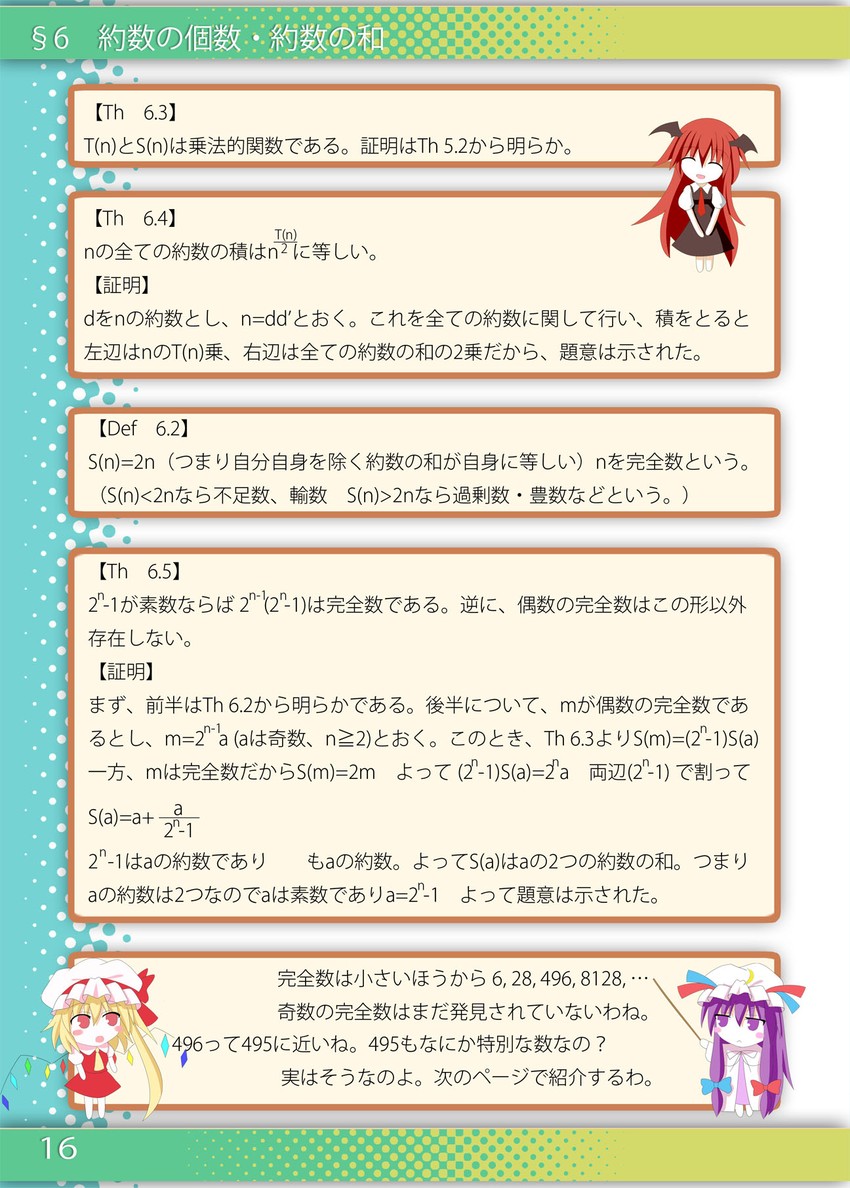
    [Definition 6.2] If for natural number n, S(n) = 2n (that is, the aliquot sum of n is equal to itself), n is called a perfect number. If S(n) < 2n, it is a deficient number, and if S(n) > 2n it is an abundant number.
    [Theorem 6.5] Given that p=2^n-1 is prime, then (2^(n-1))p is a perfect number. Conversely, all even perfect numbers must be in this form. [Proof] The first half of this question can be proven with Theorem 6.2. For the second half, if m is an even perfect number, m=pa, where a is an odd number and p>=2. Apply theorem 6.3, and we have S(m) = S(a)*2^(n-1). Since m is perfect, we have S(m) = 2m, therefore S(a)*2^(n-1)=pa. Divide both sides by 2p-1 and we have S(a) = a + a/p. Since S(a) is an integer, p must be a divisor of S(a). Since a is also a divisor of a, a + a/p must be the sum of all two of a's divisors. Therefore, a is prime and a = p, Q.E.D.
    Number of Divisors, Sum of Divisors
    [Theorem 6.3] T(n) and S(n) are multiplicative functions. The proof is trivial from Theorem 5.2.
    [Theorem 6.4] the product of all n's divisors amount to n^(T(n)/2). [Proof] Suppose d is a divisor of n. Therefore, n = dd', where d' is another divisor of n. Do this for all divisors of n, and we have T(n)/2 pairs where the product of each pair is n. Q.E.D.
    Actually, it is. I'll introduce why on the next page.
    496 is really close to 495, so is 495 special too?
    The perfect numbers, starting from the lowest, are 6, 28, 496, 8128, etc. We still haven't found an odd perfect number yet.
    Terms / Privacy / Upgrade / Contact /